
Echoes, Two Bats, or Alternation?
How to Tell the Difference in Bat Call Analysis
One of the most common challenges in bat call analysis is working out whether unusual pulse patterns are caused by echoes, two bats calling at the same time, or a single bat using alternating pulses. At first glance these can look surprisingly similar, especially in compressed recordings — but there are a few reliable techniques that can help separate them.
Start by uncompressing the recording
If you are viewing a file in compressed mode, it's important to remember the gaps between the pulses aren't shown. The first step is to uncompress it so you can clearly see the spacing between pulses. In compressed recordings, echoes and overlapping calls can appear artificially close together, making interpretation much harder.
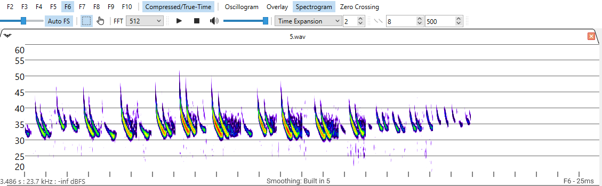
Compressed view — pulse spacing is not truly represented
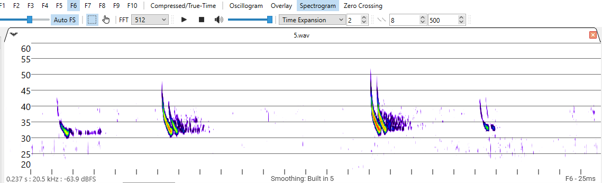
Uncompressed view — gaps between pulses are now clearly visible
Viewing the file in full spectrum is also extremely helpful whenever possible. This allows you to examine the pulse intensity or amplitude in greater detail.
How to recognise echoes
Echoes are commonly recorded when the microphone is positioned near a flat surface such as a wall, water body, or even the recorder body. The reflected sound creates a second, fainter version of the original pulse shortly after the main call. Check out our YouTube Tutorial Video on how to avoid echoes when deploying your recorders.
A few key features usually indicate echoes:
- The echo pulse closely matches the original pulse shape
- The time gap between the original pulse and echo is very close, and the gap size remains consistent throughout the sequence
- Echoes are usually weaker in amplitude than the main pulse
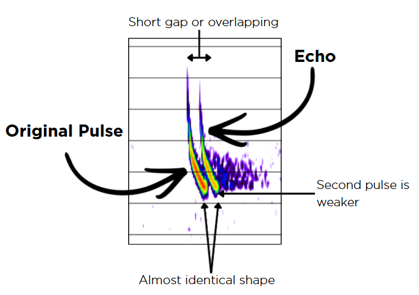
Echo example — note the similar shape and weaker amplitude of the second pulse
How to recognise alternation
Alternation occurs when a single bat switches between two pulse types during the same pass. This is normal behaviour in some species and can be diagnostic.
Alternating calls often have:
- A highly regular switching pattern
- Consistent pulse spacing
- Alternation between strong and weak pulses
- Similar amplitude trends across the entire pass — all pulses (both higher and lower frequency) start weaker, then get stronger as the bat gets closer to the microphone, then get weaker again as it flies away
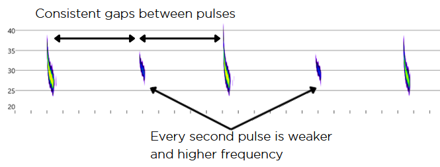
Alternation example — consistent gaps and a regular strong/weak pattern throughout the pass
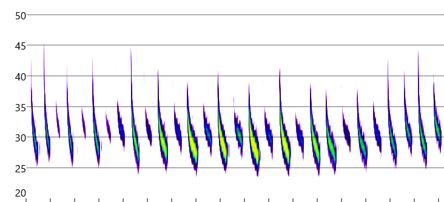
Full alternation pass (compressed mode) — note how all pulses follow the same amplitude arc from approach to departure
How to recognise two bats
Two bats calling simultaneously usually produce call sequences that behave independently of each other. Unlike echoes, the spacing between pulses is less regular because each bat is flying and calling on its own schedule.
Signs of two bats include:
- Different pulse shapes or frequencies
- Irregular spacing between pulses, especially pulse sequences that drift in and out of synchronisation
- Changes in relative amplitude of each pass as bats move closer or further from the microphone — the lower frequency pass may start strong then get weaker over time, while the higher frequency pass starts weaker and continues to get stronger
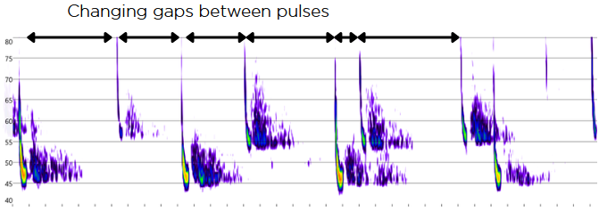
Two bats — note the changing and irregular gaps between pulses
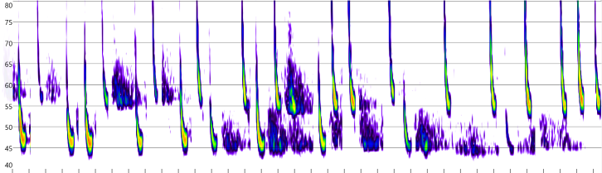
Two bats — each call stream follows its own independent amplitude trend
In many cases, one bat may dominate the recording while another appears only intermittently.
The most useful checks
When trying to distinguish between echoes, two bats, and alternation, focus on these three things:
-
1
Distance between pulses
Consistent timing between each pulse indicates alternation. Consistent paired timing indicates echoes. Irregular timing may indicate multiple bats.
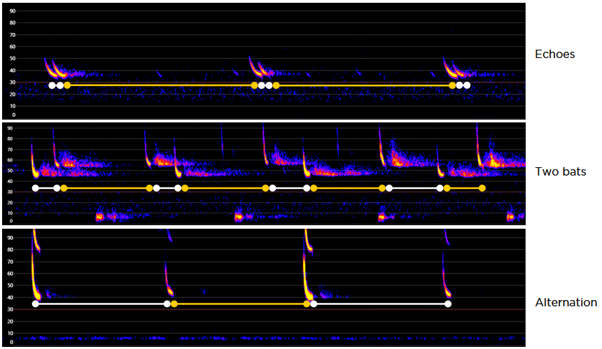
Pulse spacing comparison across all three scenarios
-
2
Pulse intensity over the pass
Echoes and alternation typically show a strong-weak-strong-weak pattern. Two bats often show independent amplitude patterns.
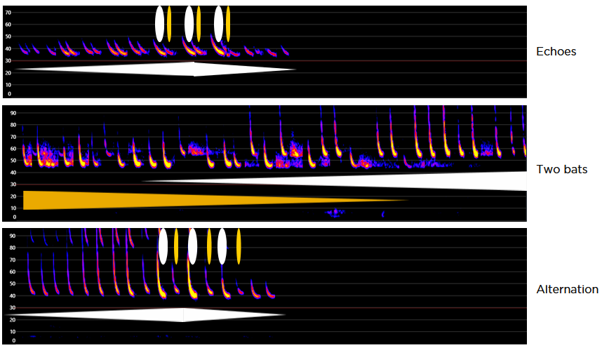
Pulse intensity comparison — note the diverging amplitude trends across the passes in the two-bat example
-
3
Overall pulse behaviour
Ask whether the sequence behaves like one coordinated pattern or multiple unrelated call streams.
With practice, these patterns become much easier to recognise. Learning to separate echoes from genuine bat activity is an important skill that improves both manual identification accuracy and confidence in acoustic analyses.